
by Brenda S. Cox
The constant attention of Mr. and Mrs. Henry Dashwood to [their uncle’s] wishes, which proceeded not merely from interest, but from goodness of heart, gave him every degree of solid comfort which his age could receive; and the cheerfulness of the children added a relish to his existence.–Sense and Sensibility, chapter 1
Jane Austen gives us delightful characters of all ages. The children tend to stay in the background, but older people exercise much influence.
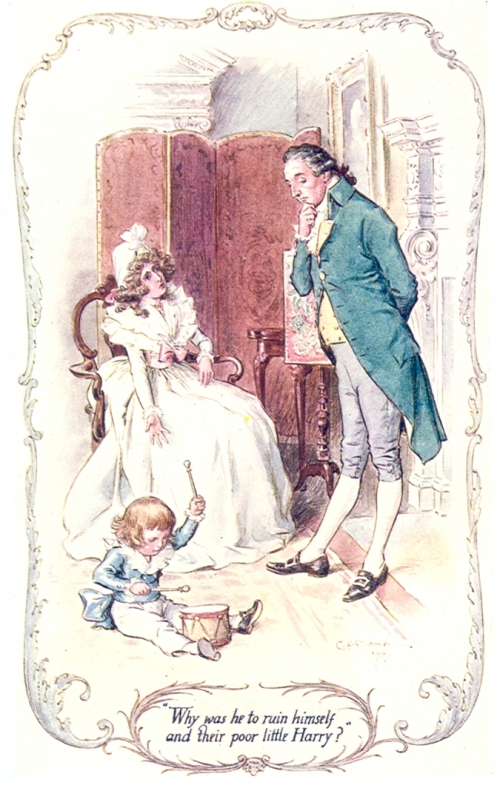
In Sense and Sensibility, of course, Mr. Dashwood, “who lived to a very advanced age,” is won over “by such attractions as are by no means unusual in children of two or three years old; an imperfect articulation, an earnest desire of having his own way, many cunning tricks, and a great deal of noise.” And so he leaves his estate tied up for the benefit of a child, leaving his nephew’s wife and daughters, who have cared for him for years, out in the cold. He is not showing much wisdom, or gratitude.
Advice from Elders, Wise or Not
The Bible says, “Wisdom is with the aged,
and understanding in length of days” (Job 12:12, ESV).
But, sadly, not all older people gain that wisdom. Jane Austen shows a wide range of wise and foolish older people.
In Pride and Prejudice, Lady Catherine de Bourgh is so used to having her own way that she is not always wise. She has no idea how to persuade Elizabeth to do her bidding.
In Persuasion, Lady Russell, on the other hand, succeeds in persuading Anne Elliot not to marry early. Anne later decides the advice was not wise. Though she does say it was “one of those cases in which advice is good or bad only as the event decides.” If Captain Wentworth had died early or not made his fortune, Lady Russell’s advice might have looked wiser.
Mrs. Gardiner of P&P gives us a positive example. She gives Elizabeth good advice about not pursuing Wickham. She does it so wisely and well that at the end, “Elizabeth having thanked her for the kindness of her hints, they parted; a wonderful instance of advice being given on such a point, without being resented.”
Mrs. Croft of Persuasion is another wise woman, who keeps her husband from driving into ditches, literally and metaphorically. Anne Elliot thinks this is “no bad representation of the general guidance of their affairs”: Mrs. Croft gently and lovingly guides her husband well. Charlotte Lucas learns to similarly guide her husband, Mr. Collins.
The Foolish and the Wise
In previous posts, we looked at the most difficult of Austen’s older characters. Mr. Woodhouse of Emma is kindly but stuck in his ways and opinions. He cannot understand the viewpoints of others, much as he tries to love them. Mrs. Churchill is much worse; she uses her illnesses, real or imagined, to control others. Neither shows real wisdom.
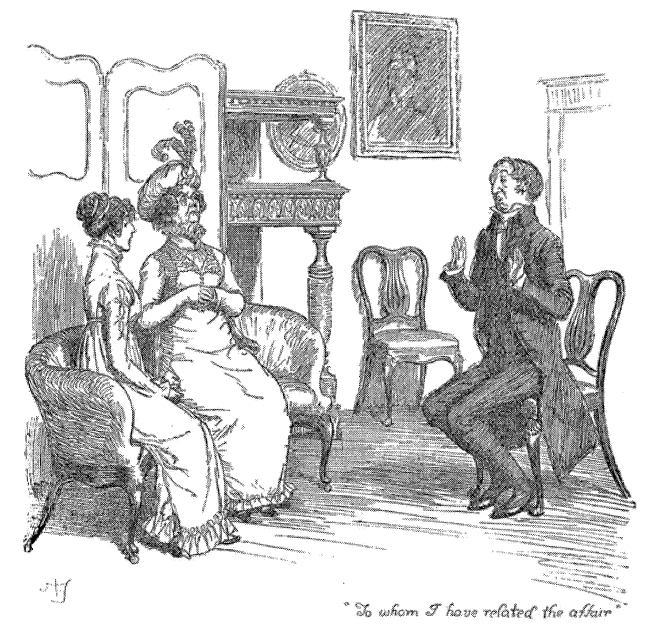
Mrs. Bennet is another Austen character who has not learned wisdom as she aged. Yes, she knows her daughters need to make good marriages; she has gained that much wisdom. But she still acts like a flighty young woman, sighing over officers. And she has no perception into her daughters’ characters, encouraging Mr. Collins to propose to Elizabeth, who obviously will not accept him. She tries, ineffectively, to manipulate others with her nerves and her complaints. Austen tells us that even the marriage of three of her daughters did NOT “make her a sensible, amiable, well-informed woman for the rest of her life.”
Real wisdom includes humility, the ability to change and learn from one’s mistakes, which Mrs. Bennet lacks. But we see it in Lady Russell. When Anne and Captain Wentworth get re-engaged, Lady Russell shows her humility by changing her opinions.
There was nothing less for Lady Russell to do, than to admit that she had been pretty completely wrong, and to take up a new set of opinions and of hopes. . . . she was a very good woman, and if her second object was to be sensible and well-judging, her first was to see Anne happy. She loved Anne better than she loved her own abilities . . .–Persuasion, ch. 24
In the same novel, the older Musgroves give different advice than Lady Russell gave Anne. When their daughter Henrietta is ready to marry, they give their approval, though the situation is not financially ideal. Mrs. Musgrove says that to “marry at once, and make the best of it, as many others have done before them. . . . will be better than a long engagement.” Her life experiences have taught her this wisdom, and wise Mrs. Croft agrees.
Mrs. Grant of Mansfield Park and Mrs. Smith of Persuasion (as well as Charlotte Collins) show another kind of wisdom. In contrast to Mrs. Bennet’s self-pity, they have learned the wisdom of finding happiness where they can. Mrs. Grant wisely tells her sister Mary,
There will be little rubs and disappointments everywhere, and we are all apt to expect too much; but then, if one scheme of happiness fails, human nature turns to another; if the first calculation is wrong, we make a second better: we find comfort somewhere . . .”–Mansfield Park, ch. 5
Mrs. Smith shows similar wisdom:
Anne found in Mrs. Smith the good sense and agreeable manners which she had almost ventured to depend on, and a disposition to converse and be cheerful beyond her expectation. Neither the dissipations of the past–and she had lived very much in the world, nor the restrictions of the present; neither sickness nor sorrow seemed to have closed her heart or ruined her spirits.–Persuasion, ch. 17
Anne calls this attitude of finding the good in every situation the “choicest gift of heaven.” These characters are following the biblical command to “Rejoice in the Lord always” and to avoid grumbling and complaining. Miss Bates of Emma is another older woman in Austen’s novels who has learned this wisdom of finding the good in life, enjoying what she has rather than complaining about what she lacks.

Growing Older with Jane Austen
Jane Austen has much more to say on growing older in her world. Maggie Lane’s excellent book, Growing Older with Jane Austen, explores this in many ways. I hope you will go over to Jane Austen’s World and read my discussion of the areas she covers. Part 1 explores the chapters on the loss of youth and beauty, one’s time of life, parents and children, old wives and old maids. Part 2 gives some highlights on older men, widows, age and money, illness, and death in Austen’s novels. I think you’ll find Lane’s insights fascinating.
I’d love to hear your thoughts–how else does Jane Austen show wisdom or foolishness in her older characters? Which one teaches you the most for your own life?
Discover more from Faith, Science, Joy, and Jane Austen
Subscribe to get the latest posts sent to your email.
 Faith, Science, Joy, and Jane Austen
This is a great article. Fresh and new about getting old. Trying to cooperate with aging myself. Thank you for this very helpful and healthy take on Age and Wisdom in Jane Austen!
>
LikeLike
Yes, Susan, me, too. Isn’t it nice to know Austen gives us some positive role models for aging, as well as negative ones?
LikeLike
Reading through this article, I suddenly pictured Eleanor Dashwood-Ferrars growing into one of the wise ones. Maybe because she’s already largely there, mature beyond her years.
Of those you mentioned, Mrs Smith is a favorite of mine. Can’t even say why, there just seems to be a deep font of experience and wisdom there, and savvy judgment to go with it.
Enjoyed this post very much!
LikeLike
Thanks, Kevin. Yes, Elinor has somehow learned wisdom later on, and I expect with Edward, and as a clergyman’s wife, she would continue to grow and gain more wisdom. Mrs. Smith has learned a lot of wisdom through suffering well, I think. I love her example of gratitude for what she has.
LikeLike