by Brenda S. Cox
“They are all reading with delight Mrs. H. More’s recent publication.”–Jane Austen, May 31, 1811.
I was excited to learn that a movie was recently produced (2023) about Hannah More, a woman I much admire. Hannah More was a writer of Jane Austen’s time, far more popular than Austen at that time, thought mostly forgotten today. She was a strong Christian woman who changed her world for the better.
Austen mentions Hannah More twice in her letters. First, Cassandra is trying to get her to read More’s only novel, Coelebs in Search of a Wife. (More wrote mostly nonfiction books and booklets.) Austen is balking, saying she doesn’t like the Evangelicals, but that she will be “delighted,” as other people are, once she reads it. We don’t have a comment from her after she read it. Later she just mentions that some women she was visiting are reading More’s new book, which was Practical Piety. Whether Austen enjoyed More’s writing, which was in a didactic, sermonizing style, or not, many others did.
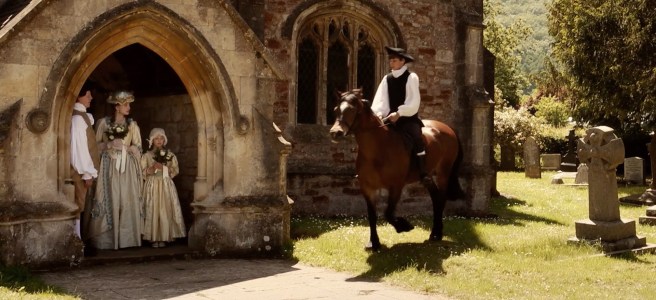
The new movie, Hannah More, from Redcliffe Film Productions , with Lily Maryon as Hannah More, implies this popularity more than shows it. It flits through Hannah More’s long and very eventful life, 1745-1833, showing vignettes at various points. Transitions are shown with black and white views of relevant places, with captions added for the year and location, and sometimes the people, in the next scene. (If these had been read aloud in the movie, that would have been helpful, as they are not easy to see on a small computer screen.)
The beginning focuses on More as a child, her delight in receiving a book, and her parents’ discussion on her intelligence. Her father, a schoolmaster, fears that too much education will make her a “female pedant,” so he cuts back some on teaching her. We are told, “In 1752, Hannah’s two older sisters open a school for girls in Park Street Bristol,” and cut to a brief scene between Hannah and another student, who are learning multiple languages. Eight years later, she’s a teacher at the school. She tells her students, “Women should strive for respect.”

Soon, Hannah gets engaged to Mr. Turner, a wealthy, cultured gentleman much older than she is. He postpones the wedding three times during the next six years. We see her several times dressed for her wedding, once in church, and each time he sends a note with an excuse to postpone. Finally, a friend negotiates an end to the engagement and an annuity of £200 a year for Hannah. This enables her to focus on writing. She never married, though she was called “Mrs. More” as a courtesy title later in her life.
The movie emphasizes plays and the theatre. Hannah More wrote several plays. She became friends with the famous actor of the day, David Garrick, and his wife (who does not appear in the movie). Garrick mentored Hannah and sponsored her first play, Percy, which did fairly well.
Hannah is also introduced to Samuel Johnson, another friend and mentor (an author Jane Austen greatly admired). Unfortunately the show doesn’t attempt to show Hannah’s wit and charm, which gave her these influential friends.
Later scenes address her controversial friendship with Ann Yearsley. Ann was a milkmaid and a poet. Hannah More got Ann’s poetry published. She put the income in a trust fund for Ann and her children, so that Ann’s husband could not access it. However, they had conflicts since Ann, not unreasonably, wanted immediate control of her own money, and Hannah wanted her to think more long-term and benefit her children.

The film explores Hannah’s close connections with the abolition movement. She meets Lady Middleton, Thomas Clarkson, and eventually William Wilberforce. There’s some discussion of Hannah’s influential poem, “Slavery.” The actor representing Clarkson does a good job pontificating on, and explaining, abolitionist views.
The first indication we get of Hannah’s Evangelical views is when she meets Wilberforce. They discuss John Newton, Evangelical clergyman and author of the hymn “Amazing Grace.” Hannah says that she has heard Newton preach and corresponded with him, and he has helped her to “follow a new path.” Her Christian faith at this point became much deeper, and that shows in all her writings.
We move to the Sunday school movement when Wilberforce visits Hannah and her sister Patty. In the film, the idea of them starting Sunday schools for the impoverished people of their Cheddar region comes from Hannah and her sister. Most sources I’ve read credit the idea to Wilberforce. In any case, Hannah and Patty agree to start schools for these very poor children, while Wilberforce pays the costs. We see some of the struggles Hannah goes through in convincing families in the area to send their children to a free school on Sundays.
The Sunday school movement, which began by teaching working children to read, was a huge step in empowering the lower classes in England and opening doors for underprivileged children. Later we see the sisters planning to start a Women’s Friendly Society. These cooperatives, connected to the Sunday schools, enabled poor women to help one another with financial needs.
Hannah More did a lot of writing during this time, challenging the upper and middle classes toward better moral behavior and deeper Christian faith. These were major goals of Wilberforce and his Clapham friends at this time. However, we don’t see that in the movie.
We do see More writing pamphlets for the lower classes, such as “Village Politics,” in efforts to avoid a violent revolution in England. The French Revolution and its aftermath brought many deaths as well as attacks on the church. Hannah More and others sought to avoid such violence in England by writing tracts helping the poor to better understand the issues. (Huge numbers of poor people could now read, because of the Sunday school movement!) They succeeded.
The latter part of the movie shows Hannah More in old age, living at her home, Barley Wood. Her sisters die, isolating her. Finally she has to leave her home since her servants have been cheating her. The movie doesn’t show it, but she continued to write influential books and had many visitors from her admiring fans during her final years.
In 1833, she hears that her friend William Wilberforce has died, shortly after the abolition of slavery in the British Empire. A friend tells Hannah More that her legacy is the education of a thousand children. That was only part of her legacy, however, since she also contributed hugely to the anti-slavery campaign and campaigns for moral reform. More says, “I was happy to serve, and now I’m happy to go.” She died that fall.
The movie gives an overview of More’s life, with many interesting vignettes. Some parts of her life are left out; no doubt they had to make many hard choices of what to include. It’s a low budget movie, but works decently as a documentary. Knowing some of Ms. More’s story may help make it clearer.
The settings were excellent, using authentic Bristol locations appropriate to the time period, with appropriate furniture. The costumes are Georgian era, moving to Victorian, skipping the Regency, but they worked for the show. I enjoyed a scene of the women in the kitchen, several scenes at the theatre, and seeing ladies carried in Bath chairs.
The actors spoke with a British accent that my husband and I, Americans, found a little difficult to understand, especially from the children in the first bit of the movie. However, after that, the actors spoke more clearly and were easier to understand. Some of the dialogue unfortunately was stilted, as if they were reading from scripts. A reviewer says the movie is better quality on the big screen, so you might want to try watching it on a larger screen at home.
I am planning to visit some sites related to Hannah More in England next month, and this movie gives me a taste of what’s available. I look forward to sharing with you what I see there.
You can watch the movie for free on youtube, with captions making it easy to understand, or on Prime Video or for a nominal fee in HD on amazon.
For another perspective, you can watch on youtube “The Extraordinary Life of Hannah More—and Her Connections with Jane Austen.” Rev. Paula Hollingsworth, who wrote The Spirituality of Jane Austen, is the speaker. This is not dramatized, of course, like the movie.
Who is your favorite heroine who has changed the world?
If you’d like to read more about this amazing woman’s life, I recommend chapter 31, “Hannah More: Influencing Society” of my book, Fashionable Goodness: Christianity in Jane Austen’s England, or, for a more thorough version, Fierce Convictions: The Extraordinary Life of Hannah More, Poet, Reformer, Abolitionist, by Karen Swallow Prior.
Discover more from Faith, Science, Joy, and Jane Austen
Subscribe to get the latest posts sent to your email.
 Faith, Science, Joy, and Jane Austen