By Brenda S. Cox
Emma “depended on the evil feelings of the Eltons for supplying all the discipline of pointed neglect that could be farther requisite.”— Emma, Vol. 3 chapter 3
Among Jane Austen’s many fictional clergymen, three are heroes: Edmund Bertram, Henry Tilney, and Edward Ferrars. Three others are not exactly villains, but are not admirable men: Mr. Elton, Mr. Collins, and Dr. Grant.
Are any of Austen’s Clergymen “Evil”?

Public Domain via wikimedia
In a recent article, I wrote that
Jane Austen “shows the foibles and flaws of some clergymen, but she does not show them as evil. In fact, in Mansfield Park she strongly defends the clergy. She probably did not expect Mr. Collins to be her most famous clergyman.”
What I meant was that we can’t call any of Austen’s clergymen wicked. None of them are gamblers, like Wickham, or seducers, like Willoughby. They are not even heavy drinkers, as John Thorpe may end up, or extravagant men who don’t pay their debts, like Sir Walter Elliot. We would not expect any of Austen’s clergymen to practice these vices.
All of Austen’s clergymen, as far as we are told, faithfully fulfill their duties as clergymen: leading worship services, preaching, visiting the poor and sick, and so forth.
So, what flaws do Austen’s “bad” clergymen have?
Mr. Elton

C.E. Brock, Public Domain.
One of the worst things any of Austen’s clergymen does is in Emma, when Mr. Elton, with his wife’s encouragement, blatantly refuses to dance with Harriet. Austen labels this as “impertinence,” “unpardonable rudeness,” and “a littleness about him.”
However, an editor pointed out to me that Austen does identify the Eltons as “evil.” After that ball, Emma hopes Harriet will be cured of her crush on Mr. Elton. To help that process, Emma “depended on the evil feelings of the Eltons for supplying all the discipline of pointed neglect that could be farther requisite.” Is Austen saying Mr. Elton is evil?
The word evil has a range of meanings, and Austen used it more than sixty times in her novels. Usually it means something bad or unpleasant, such as “the sad evils of sleeping two nights on the road” or “the evil day [of Jane Fairfax leaving the Campbells] was put off.” Darcy says that everyone has “a tendency to some particular evil—a natural defect.”
Austen doesn’t call people evil, at least not that I have found. She does, though, call Henry Crawford and Maria Rushworth’s actions evil, when they commit adultery. But Austen doesn’t create the sort of evil villains that other novelists of her time punished severely in their novels. In Austen’s novels, people have a balance of good and bad traits.
The Eltons are not called evil, but they have “evil feelings.” Samuel Johnson’s Dictionary of the English Language (1773) gives several meanings of “evil.” The one Austen is likely using here is “mischievous, destructive.” The Eltons will likely continue showing unpleasant attitudes towards Harriet, but that will only serve to open her eyes further to Mr. Elton’s unpleasant character.
Mr. Elton is also vain and ambitious. He thinks highly of himself and hopes to move up in society and gain wealth by marrying Emma. To be fair, she appeared to be encouraging him, though she is shocked when he proposes. We might consider him foolish, as well, for marrying an unpleasant woman like Mrs. Elton, but he did gain a moderate fortune through his choice. And the two of them seem well-matched in their snobbery. Mr. Elton, however, seems to feel a little shame for his treatment of Harriet once Mr. Knightley asks her to dance. Seeing this, Emma thinks he is not “quite so hardened as his wife, though growing very like her.”
Mr. Elton does have a reputation as a good preacher, “excellent in the church.” He visits a poor family and appears to be diligent about parish meetings and providing for the needy. So, while he is rude to Harriet and vain, he is not all bad.
Mr. Collins

C. E. Brock, Public Domain.
What about Mr. Collins of Pride and Prejudice? He is pompous, proud, foolish, and obsequious. Pride is a sin, according to the church he supposedly served, but his pride is mixed with extreme humility, a virtue. Austen tells us the source of some of his weaknesses. Mr. Collins had a difficult upbringing, under “subjection” to an “illiterate [not well educated] and miserly father.” He has little experience with the gentry—notice his extravagant compliments to middle-class Mrs. Phillips. At heart, he seems to be insecure, not knowing what to do, and too ready to take guidance from Lady Catherine. He is very fortunate to receive a living from her, right out of university and with no family connections, so he has good reasons for gratitude. He is also oblivious to what people around him think of him—he just doesn’t notice their responses.
The worst thing Mr. Collins does, in my opinion, is to write two harsh letters about Lydia. However, he is simply regurgitating conventional clichés, such as saying that her death would have been a blessing compared to her transgression. While he is certainly unkind and insensitive, his letters don’t seem to offend the Bennets. Elizabeth calls the first a “curiosity,” like his other letters. It sounds pompous, selfish, and even foolish, as Mr. Collins congratulates himself on his narrow escape from marrying into their family. But it does not seem to shock the Bennets.
In the second letter, Collins warns Elizabeth not to marry Darcy, and again condemns Lydia and Wickham: “You ought certainly to forgive them, as a Christian, but never to admit them in your sight, or allow their names to be mentioned in your hearing.” As Mr. Bennet comments, “That is his notion of Christian forgiveness!” This letter shows a failure of Mr. Collins as a clergyman. He should be encouraging forgiveness, a fundamental precept of Christianity, but he does not even understand it. Mr. Bennet encourages Elizabeth to laugh at the rest of the letter.
Mr. Collins is so foolish that no one takes him seriously, and thus he does not do much apparent harm. We do not see him interacting with the people of his parish. However, we are told that, if they complain, he turns them over to Lady Catherine, who “scolds them into harmony and plenty.” He should have been taking their side and making sure they were cared for, but he fails in that duty. He does, however, lead services and preach at the church he is responsible for.
So, Mr. Collins is probably the worst of the three clergyman, though we mostly see him as a harmless buffoon.
Dr. Grant

C. E. Brock, Public Domain.
Austen’s third “bad clergyman” is Dr. Grant of Mansfield Park. Fanny Price says that he preaches “very good sermons,” although he has “not a good temper.” He has some good traits. We see his kindness, when Fanny is caught out in the rain and he comes out himself with an umbrella to bring her into his house. Mary Crawford says he is “kind and obliging” and “really a gentleman.”
However, in biblical terms, he is a glutton. Edmund says Dr. Grant has “a very faulty habit of self-indulgence.” He is mostly concerned with his meals, and is angry with his wife if his food does not please him. Mary also says he is lazy, “his curate does all the work,” though he preaches himself.
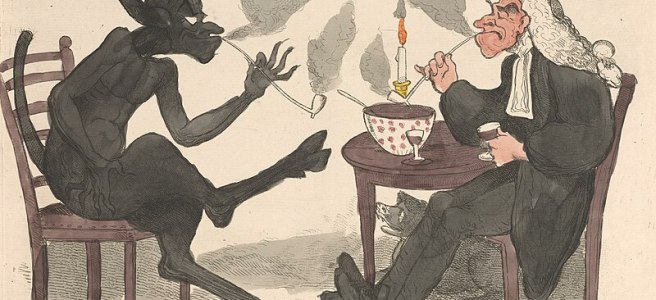
Austen is presenting a popular stereotype here. Satirical cartoons of the time often presented clergymen as fat and lazy, focused on big meals and good food. She knew this picture would make her readers laugh, as well as help explain Mary’s prejudices against the clergy. However, Austen balances these flaws with Dr. Grant’s strengths. She gives him a wife who cheerfully puts up with his weaknesses and shows Dr. Grant’s respect for his wife.
***
I still contend that none of Austen’s clergymen are evil, or wicked, at least not as we would define evil today. They all had flaws, like everyone. Austen’s clergymen were ordinary men who happened to have the right connections and education to get a church living. They were not expected to be perfect. As Samuel Johnson said, “A man who is good enough to go to heaven is good enough to be a clergyman.” (In other words, if he is saved by Christ, he can lead others in worship.) Even Austen’s clergyman-heroes have flaws: Edmund Bertram is “duped” by Mary Crawford. Edward Ferrars hides his engagement and unintentionally leads Elinor on. Henry Tilney leaves much of his church work to his curate for long periods.
Austen’s “bad clergymen” have flaws that make them entertaining. In my opinion, Austen did not intend to criticize the clergy in general, but to satirize individual flaws that might be corrected in some clergymen.
After all, would Pride and Prejudice be as much fun if it didn’t include Mr. Collins? What do you think?
For cartoon satires of clergymen in Austen’s England, see “Jane Austen’s Clergymen” ; “The Stereotype of the Self-Indulgent Clergyman”; “The Clerical Alphabet: Problems in Jane Austen’s Church of England”; and a more comprehensive article, “Satirical Cartoons and Jane Austen’s Church of England.”
Discover more from Faith, Science, Joy, and Jane Austen
Subscribe to get the latest posts sent to your email.
 Faith, Science, Joy, and Jane Austen
Pride and Prejudice needs Mr. Collins. But I think the movies should do him better service. In the book, he’s only 25, but much older in the movies. It would add so much humor to the films to see an incredibly young man acting so Collins-ish.
LikeLike
Great idea! Many of Austen’s characters are the “wrong” ages in the movies. I saw a series once that had people the correct ages playing various scenes from Austen, which was very fun!
LikeLike