By Brenda S. Cox
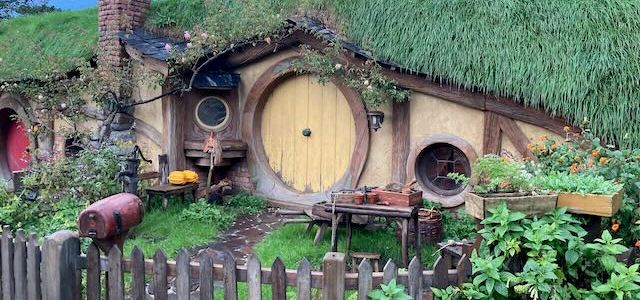
“In a hole in the ground there lived a hobbit. Not a nasty, dirty, wet hole, filled with the ends of worms and an oozy smell, nor yet a dry, bare, sandy hole with nothing in it to sit down on or to eat: it a was a hobbit-hole, and that means comfort. It had a perfectly round door like a porthole, painted green, with a shiny yellow brass knob in the exact middle.”–The Hobbit
We’re going to take a detour from Jane Austen, to another great writer, J.R.R. Tolkien. After I spoke in Wellington, New Zealand, to the wonderful Janeites there, my husband and I traveled around that gorgeous country. A highlight of our tour was seeing Hobbiton.
This sheep farm, in an area with no powerlines, buildings, or roads in sight, was chosen to host Hobbiton for The Lord of the Rings movies. Temporary hobbit houses were scattered among the hills and trees. After filming, only some plywood facades remained—but even those attracted tourists.
When filming began for The Hobbit trilogy, 44 permanent hobbit holes were built here. These became a permanent tourist attraction, Hobbiton. The village also has a pub (the Green Dragon), a well, a working pump, and roads that always lead somewhere. The farmland produces food, which the gardeners take home. The chimneys built into the hillsides are often smoking as if fires were burning inside.

In The Fellowship of the Rings, Bilbo prepares for an important birthday:
“Bilbo was going to be eleventy-one, 111, a rather curious number, and a very respectable age for a hobbit (the Old Took himself had only reached 130); and Frodo was going to be thirty-three, 33, an important number: the date of his ‘coming of age’.” Bilbo was planning an enormous party for 144 guests.


Notice the open book and the pipe on the bench.
The attention to detail in these houses is amazing. Many represent different occupations, most of which were still trades in Jane Austen’s time. Let’s look at some of them.


Can you imagine craftspeople in Austen’s village of Steventon and Chawton pursuing similar occupations to those of Hobbiton? Of course their houses and shops would be above ground. 🙂 The Industrial Revolution was starting during Austen’s time, but in the southern part of England they were still pursuing at least some traditional crafts. Mansfield Park had a carpenter, anyway. Can you think of other crafts named in Austen’s novels?
Are you feeling the joys of Hobbiton? I hope someday you’ll get to visit!
In the meantime, next week I’ll take you inside the Green Dragon and one of the Hobbit houses.
For more about my trip to Australia and New Zealand last year, see Visiting Janeites Down Under.
All photos © Brenda S. Cox, 2025
Note: If you have a different interpretation of any of these Hobbit homes, which I’ve tried to identify by craft, I’d love to hear your thoughts in the Comments!
With many thanks to Jim Wert, who helped me identify some of the occupations for the houses above.
One thing J.R.R. Tolkien and Jane Austen have in common, besides being superb English writers, is that both were committed Christians and you can find Christian themes in their books, interwoven seamlessly into their wonderful stories. I wrote about such themes from Sense and Sensibility the last two weeks.
Since my book group is currently reading The Hobbit, I’m also reading a devotional that draws out some of Tolkien’s Christian themes, A Hobbit Devotional. You might want to check it out.
You might also enjoy:
A video behind-the-scenes tour of Hobbiton
Another photo tour of Hobbiton
10 J.R.R. Tolkien Quotes that Remind Us of Scripture (with links to articles and books on Tolkien’s faith at the end)
Discover more from Faith, Science, Joy, and Jane Austen
Subscribe to get the latest posts sent to your email.
 Faith, Science, Joy, and Jane Austen
What a wonderful treat!!! Thanks for sharing your photos.
Ange
LikeLike
You’re very welcome! I was hoping some other Austen fans would love this as well, just as I did!
LikeLike
elegant!
LikeLike
Oh how absolutely lovely! 😀 I am rather jealous, haha …
I think Hobbit life + Jane Austen go together rather well actually, and it’s definitely the type of vibe/aesthetic that we’re trying to create in my little corner of the world ❤
LikeLike
I hope you’ll get to go someday, Rebecca! It is an absolute delight. And I agree, seems to go along with the Jane Austen “vibe” quite well. 🙂
LikeLike
We also visited there a few years back. It really was quite a treat!
LikeLike
So glad you got to go, Kevin!
LikeLike