By Brenda S. Cox
“We [are] quite run over with books.”–Jane Austen, Jan. 24, 1813, on books from the circulating library
If you’re reading this blog, I assume you love books—Jane Austen books in particular, but probably many other books as well. I listed a few of my other favorites in a previous post. I’m currently reading Susan Allen Ford’s book, What Jane Austen’s Characters Read (And Why). It’s a serious exploration of books mentioned in Austen’s novels, and how they relate to the stories—very interesting. But today I’m thinking about the ways we read books, whether in print or on an e-reader.

Print Books
Are you a “real books” person? You just love the feel, smell, and look of printed books? They certainly have their advantages. Here are a few:
- If there are pictures, charts, and tables, it’s easier to enjoy and refer to them in a printed book.
- I find it easier to skim through a print book and find a part I particularly liked or want to read again.
- Or, if I don’t want to read the whole book, to skim through and just read the parts that interest me. (You can do that in an e-book, I just find it more difficult.)
- You can easily lend a book you enjoyed to someone else, sharing the joy with your friends.
- You can even give it away when you’re done with it, or of course donate it to your library sale or resell it as a used book.
- And, of course, that familiar look, feel, and smell.
- Print books can be signed by the author. 😊 I do this often with my books.
Downsides: Print books do take up room on your bookshelves. If you’ve downsized to a small condo as we have, that is an important factor. They also add weight to your luggage when you travel.
We could also go into hardback vs. paperback. I have traveled so much in my life that I always prefer a paperback because it’s lighter (and usually cheaper). But hardbacks are more durable, of course.

E-Books
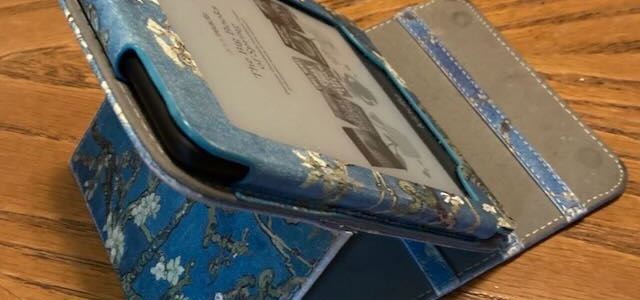
E-books have their fans as well, including myself. Here’s why I love e-books (Kindle, Apple, Nook, or whatever, though I use Kindle):
- You can search them easily. If I remember a word or phrase and I’m trying to find it, I search my Kindle book and I find it straightaway. Of course print books may have indexes, which are valuable, but the index doesn’t always have what I’m looking for.
- They’re extremely portable. I travel a lot, and I can carry a thousand books with me if I want to, in one tiny device.
- You can make the print bigger or smaller, as you like—a benefit especially as you get older. (Unfortunately you often can’t do this for illustrations or charts, which tend to be a frozen size, sometimes too small.)
- You don’t have to hold them open while you’re reading, so it’s easier on your hands and arms. I do have a nice holder for print books (my neck won’t handle leaning over a lot), but then turning the pages takes a little more finagling.
- I can read my Kindle Paperwhite at night with the lights off, not disturbing my husband or even myself (the overhead light in the bedroom apparently tells my body it’s daytime, when I want to wind down for sleep).
- Mine is also waterproof for the beach.
- And, most of the time, the Kindle version is cheaper. That means I can buy more books for the same budget. (Besides, I sometimes have Kindle Unlimited which lets me read even more books!)

Pricing
Okay, here’s my rant: Some publishers do NOT make the Kindle version significantly cheaper than the print version. (BTW, this is generally NOT the author’s choice, unless the book is self-published. Traditional publishers set prices without the author’s input, I am told.) I’ve heard this is to increase sales of the print version, but that doesn’t really make sense to me; why not increase sales of the e-book instead?
It seems to me as a reader that the e-book ought to be cheaper because:
- There are no printing costs and no shipping costs for e-books (amazon charges something to the publisher, but not nearly as much as printing and shipping).
- According to Amazon, at least, you don’t really own a Kindle book. They say, “Kindle Content is licensed, not sold, to you by the Content Provider.” In other words, Amazon owns it, you are just leasing it from them. If they decide to take it back, or block your Kindle account, they can. (Scary, right?) Anyway, you should pay less for leasing than for owning.
- In most cases, you can’t loan out your Kindle book (sometimes you can, in very limited ways), and of course you can’t resell it. So again, less value.
Therefore, in my humble opinion, E-books should always be substantially cheaper than print books. I have tried complaining about this in reviews—which Amazon won’t post, because they say prices change so you can’t mention that in reviews—and to publishers, who have not given me their reasoning.
When I come across books where the Kindle version costs nearly the same as the print version, and both are expensive, it feels like price gouging. (Of course there are books which are less than $10 for both print and Kindle, and that’s fine—great, in fact.) I want to support authors and publishers by buying books. However, I sometimes protest unreasonable prices by either buying a used copy of the book or getting it through a library or not getting it at all.

So—there’s my rant. If you have a different opinion, please tell me in the chat; I’m open to persuasion. (BTW, I’m only showing GOOD examples of pricing, not BAD examples, which might embarrass someone. But no doubt you’ve seen bad examples yourself.)
Which do you prefer, print or e-books? Why?
Do you think it’s sometimes reasonable for publishers to charge the same for both the e-book and the print book? Why?
Just for fun, let’s close with a couple of quotes about books from the Bible:
John 21:25 says:
“Jesus did many other things as well. If every one of them were written down, I suppose that even the whole world would not have room for the books that would be written.”
(This is why writers leave out lots and lots of daily details!)
and Ecclesiastes 12:12:
“Of making many books there is no end, and much study wearies the body.”
(But a little study can be fun, imho!)
On a different note–I’d encourage you to try out a new website, Jane Austen’s Desk, which I have reviewed recently on Jane Austen’s World. It’s a delight! And especially, take a look at the many books you can access from there.
Discover more from Faith, Science, Joy, and Jane Austen
Subscribe to get the latest posts sent to your email.
 Faith, Science, Joy, and Jane Austen
I appreciate your insights into e-books and physical books!
LikeLike
I’m glad you enjoyed it! Which is your favorite?
LikeLike
I love the physicality of books, but e-books have become my favorites because they are easily accessible and searchable. I’m writing a biography of Jane Austen for young readers (10-14) and find that many books about Jane (e.g. from authors Irene Collins and David Cecil) are only available as physical books. However, many classics that Jane read as a child (like Evelina and Goody Two-Shoes) are accessible digitally, which greatly enhances my story! I bought your book as an e-book and have read it twice.
LikeLike
Yes, I have the same experience! My bookshelves are full of books that are not available on Kindle, like Irene Collins’s Jane Austen and the Clergy. But I love that I can get digital classics I need for my own research on archive.org or google books, like books by Hannah More for some upcoming talks I’m giving.
I’m glad you enjoyed my book, and that I could make it available for those who like print (who appreciate being able to easily see notes, tables, etc.) and those who like ebooks (so they can search the text easily).
I hope you’ll do the same with your book. It sounds like you’ll want physical books for libraries and bookstores to offer, but my grandkids read almost all their books on e-readers, so that needs to be an option, too. Blessings to you in your project; let us know how it goes! I hope I’ll get to review it when it comes out.
LikeLike
I love real books. My only rule with them is for series books–either hardback or paperback. Not both. I like my e-reader for ARC books and having a bunch of reading material at my fingertips.
Like you, though, I think charging real book prices for Kindle books is wrong. You can’t hold them in your hands. You’re just paying to look at something on a screen. And you aren’t even buying the book. You’re buying the opportunity to read it. That’s not right.
LikeLike
Preach it!
LikeLike
Beautifully expressed. I too use a kindle for its lightness and convenience. We no longer have the large family home so it makes sense not to buy so many physical books.
I am also hoping that the author’s still get a royalty when a book is purchased on kindle? When we buy a 2nd hand copy or borrow from a friend they don’t. Not sure about borrowing from the library?
LikeLike
Authors do get a royalty when you purchase a Kindle version. Even on Kindle Unlimited, the author gets a small amount (very small, I’m told), based on how many pages of the book you read. The author gets a royalty when the library purchases a book, but not when the book is loaned out.
We also have moved into a small condo. Lots of bookshelves, but they are very full! So the Kindle is very helpful.
LikeLike
I utilize both forms – I love the feel and aesthetic of a physical book, but I also love the convenience of digital (especially at night!). I have a personal limit for ebook pricing, where I won’t pay above a particular amount, because otherwise I might as well go ahead and buy the physical.
As a former librarian who was involved in buying ebooks (and digital audios) for the library collection, I can attest that ebook pricing is ridiculously convoluted. If you think it’s bad for the direct consumer, you should see the chaos that is library licenses and pricing … So bad. So so bad.😬
LikeLike
I’m sorry to hear that, Rebecca, because I read ebooks from my library all the time. I guess it’s complicated for the librarians, though!
LikeLike