Book Review by Brenda S. Cox
“Our family . . . are great Novel-readers & not ashamed of being so”—Jane Austen, letter to Cassandra, Dec. 18, 1798
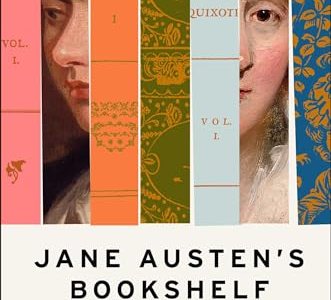
What lover of books doesn’t enjoy a book about books? I’ve just finished two fascinating books about the books Jane Austen read. Jane Austen’s Bookshelf, by Rebecca Romney, tells the stories of women writers whose work Austen admired. Next week we’ll look at What Jane Austen’s Characters Read (And Why), by Susan Allen Ford. It focuses, of course, on books Austen’s characters in the novels read—books that presumably Austen herself read.
Romney writes from a personal perspective, as a rare books dealer. She reads books Austen admired and evaluates them. She tells us those authors’ life stories and how they lost popularity over the years. She also shares her experiences tracking down, buying, and selling these old books.

The Authors
Jane Austen’s Bookshelf drew me in from the beginning. I have never been particularly interested in rare books, but I still enjoyed reading about Romney’s searches for Austen’s favorite authors.
The book includes chapters on the following authors, besides Austen herself (I’m giving just one example of each author’s works; the book includes many more):
- Frances Burney (Cecilia)
- Ann Radcliffe (The Mysteries of Udolpho)
- Charlotte Lennox (The Female Quixote)
- Hannah More (not one of Austen’s favorites, but mentioned twice in her letters; Coelebs in Search of a Wife)
- Charlotte Smith (Emmeline)
- Elizabeth Inchbald (Lovers’ Vows)
- Hester Lynch Thrale Piozzi (Letters to and from the Late Samuel Johnson)
- Maria Edgeworth (Castle Rackrent)
To me, the most fascinating parts of this book were the stories of the authors. You really get a feel for the life of literary women in this time and the restrictions they suffered from. Their lives could be novels in themselves.

Charlotte Smith
Take Charlotte Smith, for example, author of Emmeline (1788) and other novels and books of poems. Charlotte’s (wicked?) stepmother and her father pushed her into a marriage, at age 15, with the son of a rich London merchant. Charlotte’s husband lied, cheated on her, gambled away their money, beat her, and ended up in debtors’ prison. She had to negotiate deals with his creditors to get him out. She finally got a separation from him. (She couldn’t afford a divorce, which in any case was almost never granted to women.)
Charlotte was already known as a poet, but she began writing novels to support herself and their twelve children. However, her husband took part of her inheritance, and she had to spend years in court to get some of the rest from the male trustees of her father’s estate. Her husband still legally had the right to her income as a writer, so she had to fight to keep any of that. He even managed to block the legacies his father had left for the children. It all sounds like a nightmare, where Charlotte’s husband, the trustees, and the courts conspired to keep her and her children in poverty.
Still Charlotte Smith managed to write and publish books—she had to, so she and her children could survive. A young lady in “Catharine,” in Austen’s Juvenilia, calls Mrs. Smith’s novels “the sweetest things in the world.” That character’s favorite is Emmeline, the Orphan of the Castle. One of the characters in Emmeline, Mrs. Stafford, parallels the author’s own life in many details. She says, “Others have, in their husbands, protectors and friends; mine, not only throws on me the burthen of affairs which he has himself embroiled, but adds to their weight by cruelty and oppression.”
Romney points out various ways that Smith’s novels influenced Austen’s. She also comments, “The history of English courtship novels is a literary history of women’s protest against the femme couverte”—the idea that it’s enough for a woman to be under the “protection” of her husband (or father), not needing her own rights. Charlotte Smith “wrote herself free” from her husband’s abuse and neglect.

Ann Radcliffe
In some cases, Romney also traces when and how the author disappeared from “canon,” the list of “classics” everyone should read, while Austen stayed on the list. It was not because these authors were no good. They were very good, and that’s why Austen enjoyed them.
Ann Radcliffe apparently disappeared from the lists because of slander. Romney calls Udolpho “one of the best reading experiences” she has had. Certainly Catherine Morland and Henry Tilney loved it, so likely Austen did as well. However, after Radcliffe’s fifth very popular novel, The Italian, appeared, she stopped publishing. Many thought she had died. A few years later, a rumor circulated that she had gone mad. Critics thought “the terrors she had created on the page had wreaked havoc on her own mind.”
In reality, Radcliffe had always “disliked attention and avoided it.” Few personal details about her were available. She had simply withdrawn from public view, spending time with her husband, traveling and taking walks in the woods. After her actual death, her husband authorized a biography that told the true story. However, rumors had taken hold and could not easily be shaken off. Changes in the popularity of genres also played a part in her books no longer being read: the Gothic horror novel went out of fashion.

Hannah More
I was less happy with Romney’s treatment of Hannah More. Romney tells us of the extreme popularity of More’s Coelebs in Search of a Wife. It was a turning point in the history of novels, finally making novels “respectable.” Romney, though, had difficulty finishing the novel or biographies of More. (I myself have read Coelebs a couple of times, and multiple biographies of More, which I found fascinating.) Romney says she admired More, though:
“I had to admire her ambition when she wrote a letter to a famous theater manager, hoping to suggest ideas to him for plays she could write. She earned my respect by taking action to effect meaningful change in the world: supporting the education of women and working-class children, or composing abolitionist poetry to drum up popular support while Parliament debated ending the slave trade.”
Romney realized that her aversion to More came from her personal feelings against the “conservative religious community” in which she grew up. However, she affirms More’s very positive contributions to the world.
Romney was surprised to find that More’s Strictures on the Modern System of Female Education echoed “proto-feminist” Mary Wollstonecraft’s ideas on women’s education, in accord with our more modern ideas. Romney suggests that More’s ideas from this book are reflected in Mansfield Park. She concludes that we should not stereotype authors:
“When we flatten people from history into icons—Hannah More, the self-righteous moral authority; Mary Wollstonecraft, the rebellious feminist; Jane Austen, the quiet literary genius; Ann Radcliffe, the mad artist—it is so much harder to recognize their humanity, which is where their artistry ultimately lies.”
None of those epithets (“self-righteous,” “rebellious”) tell the whole story, and some are downright false. I have only given you a taste of a few of these amazing authors. I recommend that you read Jane Austen’s Bookshelf yourself to find out more of these authors’ stories, then choose which of their novels you want to read for yourself!
By the way, I was introduced to the book by an episode of Austen Chat, The Women Writers who Inspired Austen: A Visit with Rebecca Romney. It interested me enough that I bought and read the Kindle edition of the book.
These writers of the past, including Jane Austen, presented their own moral visions and ideas through fiction. Story is a powerful, memorable, and enjoyable way to present and experience truth. Jesus did that in His parables. What’s a recent novel you’ve read that impressed on you a spiritual lesson in the form of a story?
Discover more from Faith, Science, Joy, and Jane Austen
Subscribe to get the latest posts sent to your email.
 Faith, Science, Joy, and Jane Austen
Jane Austen’s Bookshelf sounds fascinating. I loved What Jane Austen’s Characters Read (And Why) and will look forward to your next post!
LikeLike
Jane Austen’s Bookshelf sounds fascinating. I loved What Jane Austen’s Characters Read (And Why) and will look forward to your next post!
LikeLike
I enjoyed Romney’s book as well. You asked about novels we are reading that impressed us with a spiritual lesson, and I highly recommend George MacDonald’s historical fiction. I’m reading “What’s Mine’s Mine” set in the time of the Highland Clearances in Scotland, and for me, it has been a strong encouragement to draw closer to the Savior.
LikeLike
I want our Jane Austen book club to read this book. I’m particularly interested in your analysis of Romney’s view of Hannah More–a woman who changed her society in so many ways.
LikeLike
Yes, and Romney recognizes that. I’m reading Strictures right now and finding some pretty modern views. In the chapter I’m reading now, More says that, in teaching religion to children, you need to understand your learners, make it fun and interesting for them, use stories like Jesus did, make it relevant to their daily lives (again, as Jesus did, talking about the weather, farming, trade to people involved in all that), never make it dry, dull, memorization. Sounds like an approach we would use today!
LikeLike
Thank you all! Definitely a great book club book, Donna. And, Joyce, I agree with you on George MacDonald. His Princess books have been an encouragement to me. Of course, also CS Lewis and Tolkein have powerful spiritual messages, and I know Lewis was influenced by MacDonald.
LikeLike
Charlotte Smith’s long battle over her inheritance is one of several cases considered the source of Dickens’ interminable Jarndyce v Jarndyce case in which legal fees absorbed all the estate!
LikeLike
Yes, and that’s basically what happened to Charlotte. A very sad story. I’ve never been able to get very far in Dickens’ Bleak House. All sounds quite depressing. Even worse to think of it being based on reality!
LikeLike
it is a very hard read-but there is a redemption at the end
LikeLike