
Book Review by Brenda S. Cox
“I declare after all there is no enjoyment like reading!”—Caroline Bingley, Pride and Prejudice
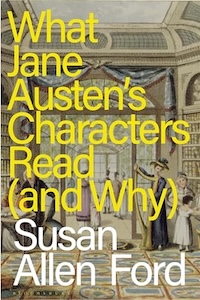
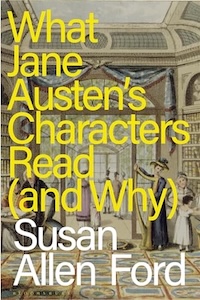
You probably know that this famous statement, found on the £10 note, is actually by a character who was not interested in reading. She was interested, though, in a man who enjoyed books (Mr. Darcy). How Austen’s characters interact with books, and which books they read, tells us a lot about them. Susan Allen Ford analyzes how those books expand and underpin Austen’s plots. She says:
“What Jane Austen’s Characters Read (And Why) will consider some ways Austen creates characters with particular reading experiences and, as she flags particular titles, strengthens the plot designs and thematic texture of her novels.”
Ford’s approach is more academic and analytical than that of Rebecca Romney, whose Jane Austen’s Bookshelf I reviewed last week. Ford gives insights into the many books mentioned in Austen’s novels and what they add to the characters, plots, and themes of those novels. I’m just going to give you a taste of a few of the more faith-oriented ones, which interest me, but be aware that Ford delves into a wide range of books.
The first chapter describes Austen and her community of readers. The many books that we know Austen owned are listed, plus others that she read, some borrowed from circulating libraries and book societies. In her letters, Jane evaluates books from her perspective as a writer, talking about whether they are natural and probable, well-written or not.
Marianne Dashwood and William Cowper
The second chapter explores Northanger Abbey and Sense and Sensibility. Catherine Morland and Marianne Dashwood are both “great readers,” of course, deeply influenced by what they read.
William Cowper (pronounced cooper, btw) is one of Marianne’s favorite authors, as well as one of Jane Austen’s own favorites. Cowper’s raptures over spring, nature, and landscapes parallel Marianne’s own raptures and contrast with Edward Ferrars’ pragmatic realism.
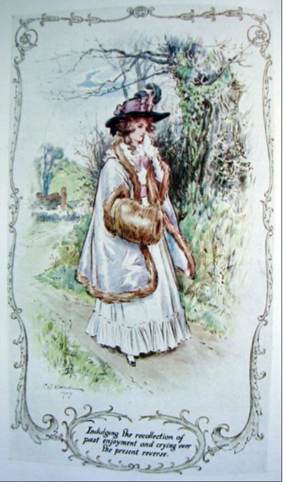
Ford wonders which of Cowper’s poems might have “frequently almost driven [Marianne] wild.” Perhaps “Yardley Oak,” a poem to an ancient, hollow tree? Or his tragic “The Castaway,” in which Cowper imagines himself washed overboard and drowning alone? Ford speculates that Cowper’s Adelphi, about his brother’s “spiritual rebirth and untimely death” might connect with Marianne’s near death and her spiritual renewal.
Marianne’s opinions reflect Cowper’s condemnation of card-playing (gambling). However, Cowper also condemns hunting (“Detested sport, that owes its pleasure to another’s pain”), which Marianne does not condemn because Willoughby does it. That love of hunting may foreshadow Willoughby’s later “cruelty” in abandoning Marianne and writing a harsh letter to her.
Pride and Prejudice and Conduct Books
In Pride and Prejudice, Mr. Collins refuses to read a novel to the Bennets, but instead begins on Fordyce’s Sermons to Young Women, a conduct book. Such books were popular reading at the time, telling young people how to behave appropriately and virtuously. Ford has written a separate article on this one, “Mr. Collins Interrupted.”
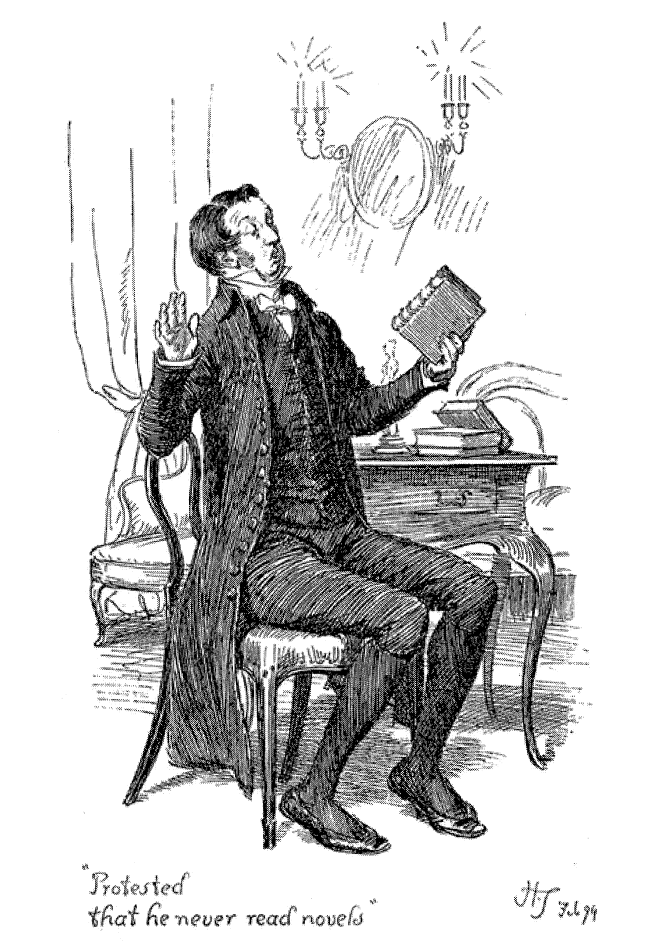
Ford traces common themes between Pride and Prejudice, Fordyce’s Sermons to Young Women and Addresses to Young Men, and Hester Chapone’s Letters on the Improvement of the Mind. For example, Fordyce warns against the dangers of wit. Elizabeth Bennet experiences some of those consequences when she gets carried away by her wit rather than taking time to judge carefully. Austen, though, shows the dangers of wit not only for women, but also for men. Darcy’s thoughtless, light words offend Elizabeth. Both have to retract their early, “witty” opinions. Austen, not surprisingly, adds to conduct book themes more nuances, humor, and depth.
Mansfield Park and Cowper
So many books are mentioned in Mansfield Park that it gets two chapters. The first explores the various plays mentioned in the book, from Lover’s Vows to Shakespeare. The second explains Fanny Price’s taste in books, which have helped form her character. Fanny reads Sir Walter Scott’s poetry, a book on an embassy to China, Samuel Johnson’s essays, and Lovers’ Vows. She quotes from Cowper’s The Task and Tirocinium (about boarding schools). Her reading is more up-to-date than that of the Crawfords, who presumably have not read much since leaving school.
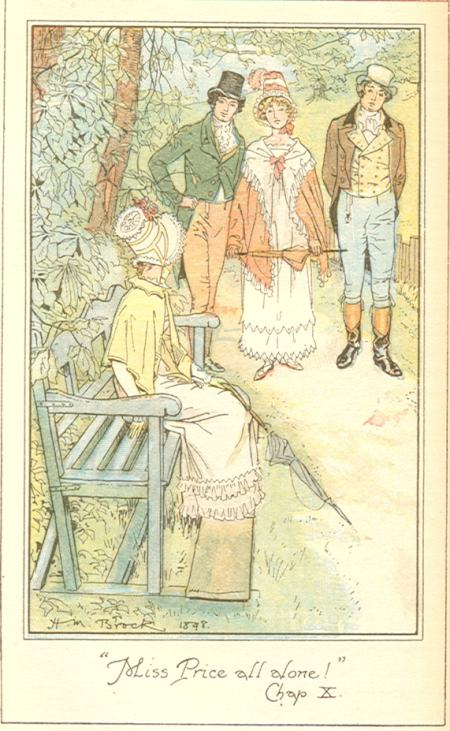
Cowper’s The Task is particularly relevant to Fanny and Edmund:
“The Task is a confessional poem, a spiritual pilgrimage that wanders from topic to topic, stance to stance. Cowper’s spiritual investigation has an obvious appeal to Edmund and Fanny, who have an “uprightness of mind” and inclination, unlike the other Bertrams, for self-scrutiny.”
Cowper’s thoughts on an “avenue” of trees being like a chapel, “re-echoing pious anthems,” reverberate in Fanny’s experiences at Sotherton. She is disappointed in the chapel and misses seeing the avenue. In a further connection, “Edmund’s intention to enter the church and the relationship between London and the rest of the nation, [are] both significant issues in The Task.”
And Much More
Later chapters explore the reading in Emma, Persuasion, and even Sanditon.
What Jane Austen’s Characters Read (And Why) can be a little heavy going at times. It includes a lot of details on various books. However, it’s worth reading for the illumination it gives on each of Austen’s novels. Austen’s original readers would have been familiar with most of the books mentioned in those novels. Ford gives us the opportunity to see what those books add to the novels, without our having to read them all ourselves. What Jane Austen’s Characters Read (And Why) can also help us to choose which of those books we would enjoy reading!
To hear the author talk about insights from her book, listen to the podcast Austen Chat number 12: Jane Austen & Her Bookshelf: A Visit with Susan Allen Ford.
At the last JASNA AGM, Ford gave a talk on Jane Austen’s own reading while she was writing Mansfield Park. That was fascinating as well, and I hope to read it in the 2024 issue of Persuasions, when that comes out for JASNA members.
Meanwhile, another article on Austen’s reading, about Dr. Syntax, is now available in Persuasions On-Line, along with other great new articles. Susan Allen Ford is the editor of Persuasions and Persuasions On-Line, so she has helped bring us lots of insights on Austen over the years. Enjoy!
What good books have affected your own life story?
Discover more from Faith, Science, Joy, and Jane Austen
Subscribe to get the latest posts sent to your email.
 Faith, Science, Joy, and Jane Austen
One thought on “What Jane Austen’s Characters Read (And Why)”