
Reviewed by Brenda S. Cox
“Jane Austen is a lot of things. She’s one of the finest novelists to write in the English language, a moral philosopher of the highest order, and a sharp social commentator. She’s also my life coach.”—Haley Stewart, Jane Austen’s Genius Guide to Life, p. xi
We all know that Jane Austen can influence our lives, right? Looking on Amazon, I see Jane Austen guides to “Happily Ever After,” well-bred insults, “Proper Life Skills,” good manners, “Food, Health, and Incandescent Happiness,” romance, “Enlightenment,” elegance and etiquette, “Good Relationships,” . . . it goes on and on.
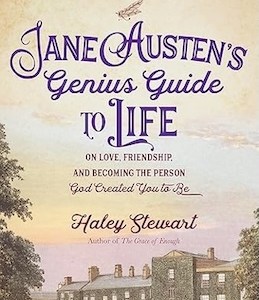
But this one is different. It’s about how Austen teaches us to live a good life, a life of virtue, a life pleasing to God. Jane Austen’s Genius Guide to Life: On Love, Friendship, and Becoming the Person God Created You to Be, by Haley Stewart, is beautifully written and a delight to read. A brief introduction to each novel gently brings on board any readers who have not read all of Austen (gasp!).
(By the way, Karen Swallow Prior’s book, On Reading Well: Finding the Good Life through Great Books, takes a similar approach to learning the virtues from great literature. However, Prior only has one chapter on Jane Austen, focused on Persuasion, so I was glad to see this more thorough, and easy-to-read, exploration of the virtues in Austen.)

While the subject is serious, Stewart uses great illustrations and a light tone that kept me reading and enjoying every page.
The first chapter calls Austen a Christian, a Philosopher, and a Comedienne (nice word). It introduces the “lively virtues” opposing the “deadly sins.” Stewart says “our lives are made up of small things.” Austen is asking, “What choices toward virtue or vice do we make as we’re going about the mundane details of our life?” That’s where the battle for our hearts takes place.
Characters and Virtues in Each Novel
In the second chapter we find Mr. Darcy learning to laugh, and Elizabeth and Darcy demonstrating pride and humility. We see the imperfections of heroes (and everyone else), with fun quotes from You’ve Got Mail and Harry Potter.
In chapter 3, “Knightley Speaks Frankly,” selfish Emma is learning compassion. We learn that “sin distorts our vision” as Emma “fails to understand herself.” In each chapter, the author gives us ways to apply these lessons to our own lives. For example,
“We can be a true friend to the Harriet Smiths and the Jane Fairfaxes in our lives if we can desire their good and learn to love others instead of merely using them. If there’s hope for Emma Woodhouse, the very worst Austen heroine, there’s hope for all of us!” (p. 40)
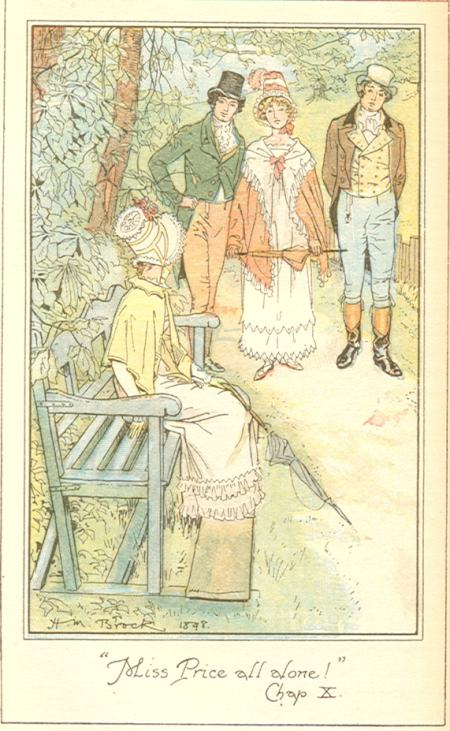
The fourth chapter is about “Fanny Price and the Stronghold of the Self.” Fanny lacks the charm that the Crawfords have—but Proverbs 31:30 says “charm is deceptive.” Instead, Fanny has the virtues. She is kind, truthful, and uncompromising: constant. She sees things as they are, “knows who she is and what she is called to be.” Gentle but strong,
“she cannot marry Henry Crawford, because that is not who she is. . . . Fanny is not the sort of person who will marry a man without substance or virtue, so she does not. She is true to herself.” (p. 46)
The chapter gives great insights on Mansfield Park and on Fanny. She is probably Austen’s least beloved, but most admirable, heroine.
In chapters about the other novels, we explore temperance, prudence, and patient endurance. (I’ll leave you to guess which is which, or, better still, read the Genius Guide!) The final chapter, “A Wedding Feast and a World Renewed,” shows spiritual implications of ending each novel with a wedding.
Chapters are a good length, with subtitles in a lovely cursive script. (I love subtitles; they guide your reading and help you return to parts you liked.)
A Catholic Perspective
The author is Catholic as is the publisher (Ave Maria Press). Stewart sometimes makes comparisons with Dante’s Divine Comedy. I imagine not all of us have read that recently, or possibly ever, but she explains well enough.

Apparently in Dante’s Purgatory, each level has a different image of the Virgin Mary, offering a virtue to counteract a vice. Likewise each of Stewart’s chapters ends with one of Mary’s titles. It’s not familiar imagery to a Protestant like myself, but still interesting, and often includes a relevant Bible story.
I think all the lessons in this book are ones that any Christian—and probably most non-Christians—can agree on, benefit from, and enjoy.
A quibble: Unfortunately, the Kindle version is currently a little more expensive than the paperback. (See my discussion of this pet peeve here.) So I got the paperback. But since it’s light and easy to handle, with nice print, I’m glad I have it.
One reviewer wrote:
“You’ll return to this book again and again for its deep voice of intelligent friendship and lively, joy-filled faith.”
Yes, I think I may well do that. I highly recommend to you Jane Austen’s Genius Guide to Life: On Love, Friendship, and Becoming the Person God Created You to Be, by Haley Stewart.
See also the review, “Jane Austen’s Greatest Lesson? Becoming the Person God Created You to Be.”
I’ve been reading Hannah More, Austen’s contemporary, who promoted the same values as Austen did, but in mostly nonfiction. Austen’s novels, presenting those values through story, are much more fun to read and have stood the test of time. Has Jane Austen been a life coach to you, encouraging you to grow in some virtue or avoid some vice?
Discover more from Faith, Science, Joy, and Jane Austen
Subscribe to get the latest posts sent to your email.
 Faith, Science, Joy, and Jane Austen
One thought on “Jane Austen’s Genius Guide to Life: Book Review”